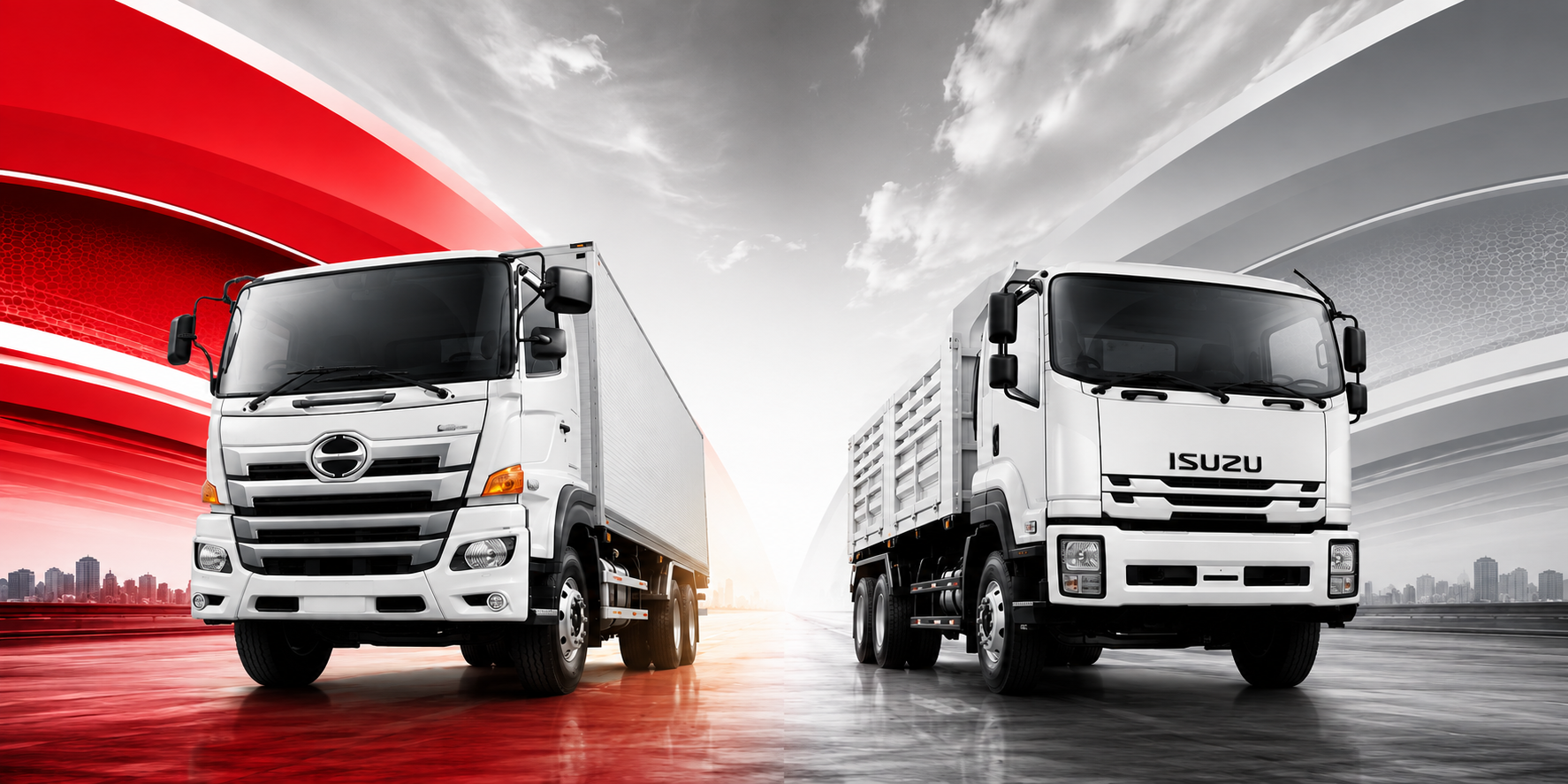
Both Hino and Isuzu dominate the Canadian medium duty market — and for good reason. They're reliable, well-supported, and purpose-built for the kind of stop-and-go urban delivery work that defines most Canadian fleets. The question isn't which one is better. It's which one is right for your operation.
Who Makes Them
Understanding the manufacturer background helps explain the parts ecosystem and dealer support you'll encounter across Canada.
| Factor | Hino | Isuzu |
|---|---|---|
| Parent | Toyota subsidiary | GM partnership history |
| Canadian Assembly | Woodstock, Ontario | Imported (US/Japan) |
| Dealer Network | Strong in ON / BC / AB | Strong Canada-wide; Humberview major in GTA |
| Aftermarket Support | Growing significantly | Growing significantly |
Model Lineup
Both brands span the full medium duty GVW range — roughly 12,000 to 33,000 lb — with model families that overlap closely in application.
Hino
Isuzu
The rough GVW overlap means most body-up applications — dry van, flatbed, reefer, service body — can be spec'd on either platform. The choice often comes down to dealer proximity and driver preference.
Browse all Hino parts → Browse all Isuzu parts →
Engine
Both brands run proprietary diesel engines, which means parts are brand-specific and not interchangeable.
| Detail | Hino | Isuzu |
|---|---|---|
| Common Engines | A05C, J08E | 4HK1, 6HK1 |
| Reliability | Strong track record | Strong track record |
Neither brand has a clear reliability edge at this point. Both have strong track records in Canadian operating conditions — cold starts, salted roads, heavy stop-and-go duty. Proper maintenance intervals matter more than the badge.
Cab & Driver Comfort
Driver retention is a real cost for fleets, and cab comfort plays a role. Both trucks offer tilt-cab designs for engine access, which simplifies routine maintenance.
| Feature | Hino | Isuzu |
|---|---|---|
| Interior Feel | Slightly more car-like | Slightly more utilitarian |
| Visibility | Good | Good |
| Tilt Cab | Yes | Yes |
| Driver Preference | Often cited as slightly more refined | Functional, proven layout |
In practice, most drivers adapt quickly to either cab. If your drivers have a strong preference, let them drive both before you commit to a fleet purchase.
Common Use Cases
| Application | Best Fit |
|---|---|
| Heavy local delivery, municipal, construction | Hino 268 / 338 |
| Food delivery, landscaping, lighter urban routes | Isuzu NPR / NQR |
| Heavier haul, competing with Hino 338 | Isuzu FTR / FVR |
| Mixed urban + highway | Either — spec by GVW |
Cost of Ownership
Purchase prices are comparable across similar GVW classes. The maintenance cost difference between brands is less significant than it was a decade ago — especially as aftermarket parts have improved availability and pricing.
| Factor | Hino | Isuzu |
|---|---|---|
| Purchase Price | Comparable | Comparable |
| Maintenance Cost | Competitive | Historically perceived as slightly lower |
| Resale Value | Strong in Canada | Good |
| Aftermarket Savings | Yes — growing parts market | Yes — growing parts market |
Using quality aftermarket brake and cab parts — rather than OEM-only — is one of the most effective ways to reduce maintenance costs on either platform. The quality gap between OEM and reputable aftermarket has narrowed considerably.
Verdict
There's no clear winner between Hino and Isuzu for Canadian fleets. The right truck depends on payload requirements, your route profile, and most practically — your dealer proximity. If your nearest dealer is Hino, run Hino. If it's Isuzu, run Isuzu. Aftermarket parts availability is now comparable for both platforms.
Choose Hino if…
- Your routes are heavy-duty local or construction
- You prioritize Canadian assembly (Woodstock, ON)
- Hino resale value matters to your fleet cycle
- Nearest dealer is Hino
Choose Isuzu if…
- Your routes are lighter urban delivery
- You value the GTA dealer network (Humberview)
- Lower GVW applications (NPR class)
- Nearest dealer is Isuzu