
When a truck rolls in during a heat wave blowing warm air from the vents, the driver's complaint is simple — "the A/C quit." The diagnosis rarely is. A medium-duty air-conditioning system is a loop of parts that all have to work together, and warm air is the shared symptom of a low charge, a compressor that won't engage, a condenser that can't shed heat, or an airflow problem that has nothing to do with refrigerant at all. Throwing a compressor at it and hoping is how shops lose money on comebacks.
This guide walks through how to think about a "no cooling" complaint on a medium-duty truck — the usual suspects, how they show up differently, and the order to check them — so the right part gets replaced the first time. It's written around common Hino and Isuzu systems, but confirm your truck's exact system and refrigerant type by VIN before ordering parts.
Refrigerant handling is regulated, and the exact requirements depend on your province, territory, or jurisdiction and the refrigerant being used. Recovery, evacuation, and recharging should be performed by a properly trained and certified technician using approved equipment. Do not intentionally release refrigerant, mix refrigerant types, or recharge a system without first identifying the cause of the loss. The diagnostic thinking below is for scoping the repair and the parts; the hands-on refrigerant work belongs with a qualified shop.
First, Confirm the Complaint
"No cold air" can be two very different problems: the refrigerant side isn't cooling, or the air side isn't delivering. Separate them first:
- Is air coming out of the vents at all? Weak or no airflow points at the blower motor, cabin filter, or duct/blend-door side — not the refrigerant loop.
- Is the air moving but warm? That's the refrigerant/cooling side — the focus of this guide.
- Does it cool at highway speed but not at idle? A classic airflow-across-the-condenser clue that points at the condenser fan or engine cooling fan, not the compressor.
- Intermittent cold, then warm? Often a charge, clutch-cycling, or control issue rather than a dead component.
Symptom-First Triage
Before opening anything up, let the complaint point you at the right area:
| Driver Complaint | Most Likely Area to Check First |
|---|---|
| Little or no air from vents | Blower motor, fuse, cabin filter, ducts or blend door |
| Good airflow but consistently warm | Refrigerant charge, compressor operation or system restriction |
| Cold on highway, warm at idle | Condenser airflow, electric condenser fan or engine fan clutch |
| Cold initially, then warm | Evaporator icing, low charge, pressure-control or electrical issue |
| Warm A/C with rising engine temp | Shared condenser/radiator airflow or engine fan clutch |
| Compressor will not operate | Low-pressure protection, electrical control, belt or compressor fault |
| Noise when A/C is turned on | Compressor, clutch, belt tensioner or idler pulley |
These symptoms are diagnostic clues, not confirmation that the listed part has failed.
Five Common Reasons a Truck A/C Stops Cooling
Low or lost refrigerant charge (a leak)
The most common reason a system stops cooling is simply that the refrigerant has escaped. Refrigerant doesn't get "used up" — if it's low, there's a leak, commonly at the condenser, line-assembly hoses, O-rings, or the compressor shaft seal. The fix is to find and repair the leak, then evacuate and recharge to spec. A recharge without leak repair is a temporary patch, not a fix.
Condenser not shedding heat
The condenser is the front-mounted heat exchanger that dumps the heat the system collects. It fails to do its job when it's physically blocked (bugs, road debris, bent fins), internally restricted, or leaking. A condenser that can't reject heat drives high-side pressure up and cooling down — worst at idle and in traffic. On front-of-radiator layouts, its performance is tied directly to airflow (next point).
Insufficient airflow through the condenser
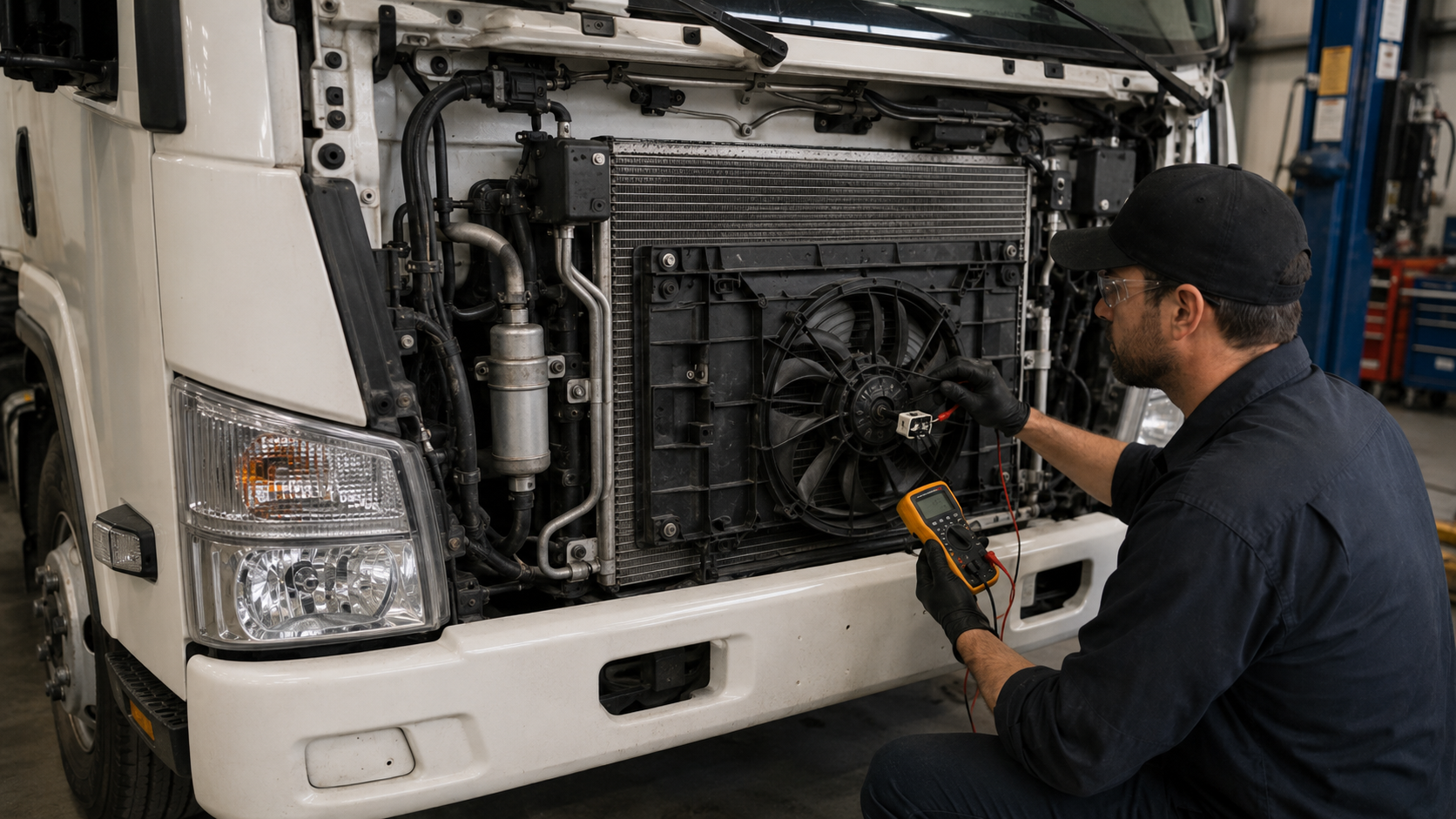
The condenser only works if air moves through it. On many medium-duty trucks the condenser sits ahead of the radiator and depends on the engine cooling fan, a dedicated electric condenser fan, or a condenser fan assembly. If that fan isn't running — failed motor, clutch, relay, or control — the system cools on the highway (ram air) but goes warm at idle. Verify that the required condenser or engine-cooling fan operates correctly under the conditions the manufacturer specifies — an engine-driven fan can be spinning without the fan clutch fully engaging and moving enough air.
Compressor not engaging or not pumping
The compressor is the pump that drives the loop. Symptoms of a compressor-side problem include a clutch that does not engage, a compressor that is not being commanded or controlled correctly, abnormal noise, seizure, a damaged or glazed belt, or pressure readings that do not match the expected operating pattern. A compressor that does not operate may be responding to a low-pressure lockout or another protective control, so verify the refrigerant charge and control circuit before condemning the compressor.
Restriction or metering problem
Refrigerant flow can also be limited by a restricted expansion valve, a contaminated receiver-drier or accumulator, a damaged hose, or debris from a previous compressor failure. Depending on the system, symptoms may include poor cooling, evaporator icing, an unusually cold or frosted line, or abnormal pressure differences. Because a low charge and a restriction can create similar symptoms, pressure readings, line temperatures, and the manufacturer's diagnostic procedure should be considered together — component layouts vary by truck and model year.
Before a big-ticket compressor or condenser goes on the quote, rule out the inexpensive causes that mimic them: a slipping or glazed drive belt, a worn A/C idler pulley, a blown fuse or failed relay, a bad pressure switch, or a plugged cabin filter choking airflow. They're cheap, common, and easy to miss when the complaint sounds dramatic.
A Sensible Diagnostic Order
- Confirm the complaint — record vent temperature, airflow strength, idle-versus-highway behaviour, and whether the problem is constant or intermittent.
- Identify the system — verify refrigerant type, charge specification, and system configuration from the under-hood label and OE information.
- Inspect mechanically — belt, idler, condenser condition, fan operation, damaged hoses, and oily residue that may indicate leakage.
- Check controls and electrical operation — fuses, relays, pressure sensors or switches, fan command, and compressor command (clutch, control circuit, or displacement-control operation, depending on the system).
- Test system performance — connect the appropriate service equipment and compare high- and low-side pressures with ambient temperature, vent temperature, compressor operation, and condenser airflow. Pressure readings help narrow the fault, but they shouldn't be used alone to condemn a component.
- Leak-test when charge loss is suspected — an approved electronic detector, dye where appropriate, or the specified leak-testing method.
- Recover and measure the refrigerant — this confirms the amount actually present more reliably than estimating charge from pressure alone.
- Repair, evacuate, and recharge by weight — using the specified refrigerant type, oil type, and charge amount.
Always work to the vehicle manufacturer's service procedure and specifications — refrigerant type, charge amount, and system layout vary by make, model, and year. Note that R-134a and R-1234yf systems use distinct service equipment and fittings to prevent cross-contamination.
A/C vs. Engine Cooling — Don't Confuse Them
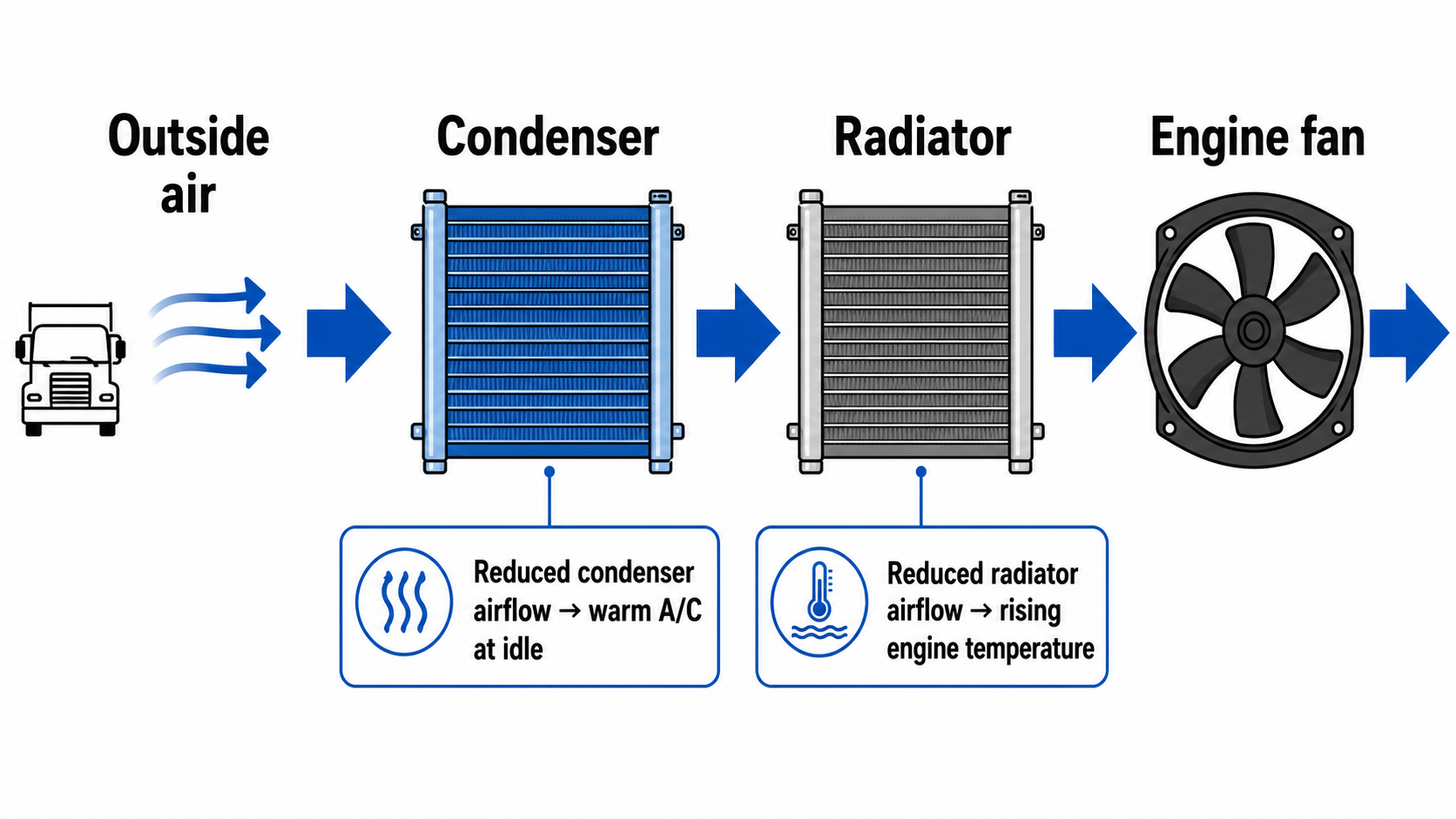
An overheating engine and a warm cab are different complaints, but they overlap at the front of the truck because the condenser and radiator share the same airflow. A failed engine cooling fan clutch can show up as both a rising temperature gauge and weak A/C at idle, because the same lost airflow starves the radiator and the condenser at once. If you're chasing warm A/C that's worst at idle and the temperature gauge is also creeping up, check the fan clutch before assuming two separate faults.
The Fleet Takeaway
A/C isn't a luxury on a working truck — it's a driver-retention, fatigue, and safety issue, and a down truck in July costs the same as a down truck for any other reason. The two things that keep A/C off the comeback list are diagnosing with gauges instead of guessing, and fixing the leak rather than topping up the charge.
For a fleet, the practical move is to catch A/C complaints early (a system that's "not quite as cold" is often an early leak), and to stock the common failure parts for your models — condensers, condenser fan assemblies, compressors, line hoses, and fan clutches — so a diagnosed fault doesn't sit waiting on parts during the season you can least afford it.
- Confirm airflow at the vents vs. warm-air-only (airflow vs. refrigerant side)
- Verify condenser-fan or engine-fan operation and airflow — especially when cooling is poor at idle
- Inspect the drive belt and idler pulley
- Inspect the condenser, hoses, fittings and compressor for oily residue or physical damage that may indicate a leak
- Test performance with certified equipment before condemning parts
- If the charge is low, locate and repair the leak before recharging
- Evacuate and recharge by weight to the OE spec and refrigerant type
Frequently Asked Questions
Why is my truck's A/C blowing warm air?
Common causes include a low or lost refrigerant charge from a leak, a compressor that isn't engaging or building pressure, a condenser that can't shed heat (blocked fins or a dead condenser fan), or an electrical/control fault. Warm air is a symptom, not a diagnosis — the system needs to be checked with gauges by a qualified technician before parts are replaced.
Can I recharge a truck A/C system myself?
Refrigerant handling is regulated, and the requirements depend on your province, territory, or jurisdiction and the refrigerant type. Recovery, evacuation, and recharging must be done with approved equipment by a trained, certified technician — don't intentionally release refrigerant, and a top-off without finding the leak just wastes refrigerant and masks the real fault. Have the system diagnosed and serviced by a qualified shop.
How do I tell if it's the compressor or the condenser?
Both can cause warm air, but they show different signs. A compressor problem often means the clutch won't engage, the compressor is noisy, or system pressures are abnormal. A condenser problem usually shows as high-side pressure that's too high with poor heat rejection, often traced to blocked fins or a non-running condenser fan. Gauge readings and a proper inspection separate the two.
Does the engine cooling fan affect the A/C?
It can. On trucks where the condenser sits in front of the radiator and shares airflow, a failed engine cooling fan clutch or a dedicated condenser fan that isn't running reduces airflow across the condenser, which drives high-side pressure up and cooling performance down — especially at idle and low speed. Confirm the fans actually spin as part of any A/C diagnosis.